Empirical trade / master's thesis
When do critical-mineral export controls bind?
China's licensing regimes, supplier switching, and import pressure.
Do importers replace Chinese supply after a licensing control, reduce total imports, or pay a segmented price?
A legal announcement is not automatically a binding trade restriction. Product coverage, licensing practice, Chinese market power, and outside replacement capacity all shape the response.
The thesis builds mineral-specific evidence rather than forcing graphite, antimony, bismuth, tungsten, and related products into one pooled effect. The estimates below are preliminary and diagnostic.
01 / Baseline
A source-specific trade response
The baseline PPML specification compares bilateral imports from China and other suppliers around the relevant control date while absorbing importer-product-source, importer-time, product-time, and source-time shocks.
D identifies a controlled product imported from China after the policy takes effect. Separate models then test whether non-China supply rises, total imports compress, or China and outside suppliers face different unit-value changes.
02 / Framework
Exposure is not the same as pressure
The thesis starts from importer-product exposure to China, then asks how much of that exposed demand can plausibly move elsewhere. Pre-policy rest-of-world sourcing captures revealed importer access; product-level production outside China captures external availability.
The identity splits China exposure into two possible adjustment margins. These are diagnostic gradients, not independent structural parameters.
03 / Design
Four pieces of evidence
- 01
Audit legal scope and map controlled material to observable HS products.
- 02
Measure pre-policy dependence on China and non-China replacement capacity.
- 03
Estimate China-source, rest-of-world, and total-import responses separately.
- 04
Use event-time and price-wedge estimates as diagnostics, with product-level pre-trend checks.
04 / Preliminary results
No single mineral story
| Product | China source | ROW switching | Total imports | Price wedge |
|---|---|---|---|---|
| Natural graphite | -30.1* | +34.2*** | -16.5** | -6.7* |
| Antimony metal | -86.7*** | +40.5*** | +28.7 | +46.0*** |
| Bismuth | -74.4*** | +19.6 | -13.4 | +83.7*** |
| Tungstates | -15.2 | +16.1 | +44.1*** | -11.5** |
Approximate percentage effects from product-specific PPML and price specifications. Stars: * p<0.10, ** p<0.05, *** p<0.01. Samples and identifying variation differ across columns, so entries should not be added mechanically.
05 / Reading
Bindingness is product-specific
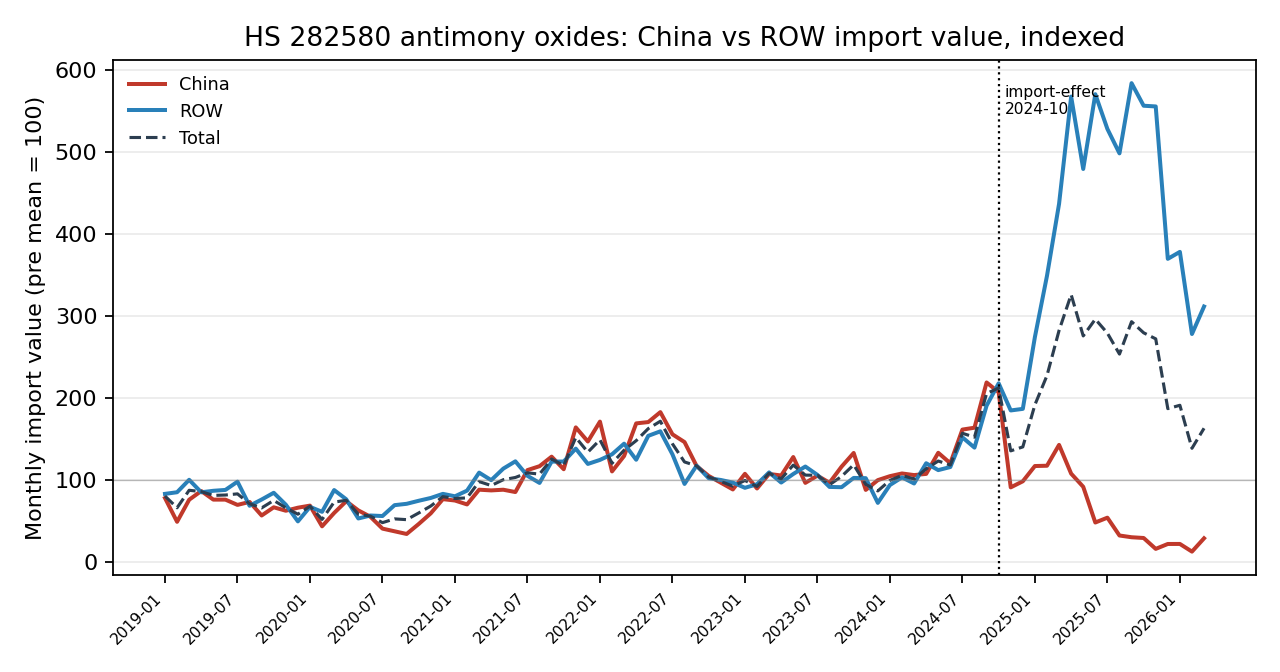
Large China-source declines for antimony metal and bismuth coexist with different adjustment margins. Antimony shows strong outside-supplier growth and a positive price wedge; graphite combines source switching with total-import compression. Tungstates do not show the same China-source decline.
Pooled event studies currently fail some pre-trend tests, and broad HS codes can mix controlled and uncontrolled material. The thesis therefore treats timing plots as diagnostics and makes its strongest claims at the product level.
06 / Tools
Tools and sources
The repository contains code, documentation, selected aggregates, and explicit replication boundaries. Raw trade panels and licensed Bloomberg or Wind data are not redistributed.